Dienstag, 28. August 2012

The Top 3 Rules to Understand About Gold & Silver Price Behavior

The Top 3 Rules to Understand About Gold & Silver Price Behavior

smartknowledgeu's picture


Over the past 10+ years of this gold and silver bull, I’ve seen gold and silver "newbies" repeatedly make the same mistakes. So I’ve decided to write this short article to help people more clearly understand gold and silver price behavior. There are 3 solid rules to follow and understand when buying gold and silver bullion and or mining stocks. Because of the lack of understanding of these rules, many investors unfortunately unload gold and silver assets at the exact wrong time, at the bottom of long corrections and right at the beginning of huge new legs higher. Back in mid-May, when I wrote that it was a very low-risk, high-reward point to buy gold and silver assets, virtually no one outside of the very small circle of seasoned gold and silver investors were interested. Now that gold and silver have risen considerably since that point and time, there is more interest than just a few weeks ago, but again, some newbies will make the mistake of buying into gold and silver now, and on any slight pull back, listen to the doubts disseminated by the mainstream media, and panic sell again.

I previously stated on August 16, 2012, the following: “The one thing I can guarantee, however, is that when gold and silver finally make new highs, and they will, some of the ferocious moves higher are absolutely going to stun a lot of people.” And I still stand by this statement. In retrospect, I don’t consider the recent moves in gold and silver to be part of the “ferocious moves higher”. That hasn’t happened yet and we're still a bit away from the manifestation of the scenario that will trigger these moves. Still, some of the moves higher in gold and silver that will happen over the next 1-2 years will be so rapid and shocking that to most people, they will seem impossible given the psychological damage done by the past 18-month gold & silver correction and consolidation period. And to those that pay too much attention to the mainstream financial press and not enough to the realities of the physical, not paper, gold and silver markets, these violent moves higher will be likewise shocking.

Because gold and silver have been so suppressed for an extended period of time the consequent defensive actions of exiting PM mining stocks and re-purchasing them at solid re-entry points has left many gold and silver investors weary and with a negative outlook ahead. Though patience is a virtue when holding and stacking gold and silver assets, this virtue is much more easily vowed than practiced, especially during volatile periods of price behavior upward and downward during an extended consolidation phase. However, those that are able to see through the volatility games of banksters will see something entirely different – a solid base for gold and silver’s next move higher to escape the banking cartel’s price suppression schemes. Thus, even though it is likely for gold and silver assets to take a breather this week and for a pull back in prices to happen before the upward trek continues, whether gold and silver are rising or falling, every gold and silver investor needs to understand the top 3 rules when holding gold and silver assets. So here they are:

(1) Volatility Does Not Equal Risk.
Far from it. In fact most volatility in gold and silver is deliberately manufactured by the banking cartel, and is manufactured in fake paper derivative markets in which prices are set with absolutely zero regard for the actual physical supply and physical demand determinants of these two precious metals. Furthermore, since banker cartel manipulation of paper gold and silver derivatives plays such a big role in price volatility, moves in gold and silver are often just as violent to the upside as they are to the downside after long periods of consolidation, as violent moves higher are often caused by short-covering of panicked hedge funds and banking cartel members that are forced to unwind shorts when the momentum to the upside becomes too great for them to suppress. Furthermore, after brief periods of very quick rises, another short-term correction triggered by day traders taking profits and/or desperate banking cartel members actions in paper markets does not mean the uptrend has reversed back downward again…which bring us to Rule #2.

(2) Lack of Patience is the Greatest Enemy to Buyers of Gold, Silver and PM Mining Shares.
With physical gold and physical silver, bankers deliberately create massive volatility in paper prices at times to discourage the uninitiated from buying physical and to try to goad those already in to mistakenly sell. With PM mining shares, the greatest mistake investors make with this asset class is to let the bankster created artificial volatility in mining shares discourage them into selling out of all of their shares right before the next great leg higher. While it is true that the vast majority of gold and silver mining shares in the junior resource sector are junk and inflated pipe dreams, even cashed-up, solid junior mining companies will be taken down in price during bankster raids on paper gold and paper silver and thus, patience with junior mining companies is essential to coming out on top.
One of the top performing gold stocks lost more than 50% of its value a few years before the onset of the Great Depression before going on a spectacular +1,258% run higher that ended in1939. Those that were impatient because they were unable to see the big picture of the importance of gold during periods of severe economic instability sold out when this stock corrected sharply, locked in losses, and received none of the spectacular gains. Many today will repeat this same exact mistake.

(3) Ignore the White Noise and Disinformation Anti-Gold/Anti-Silver Campaigns of the Commercial Banking Industry.
Clients that allocate money to physical gold and physical silver purchases or PM mining share purchases translates into lost revenues for fee-based managed money commercial banking and brokerage firms because this normally translates into money that leaves these firms and never comes back. Thus, the vast majority of commercial banking/brokerage firm employees have great incentive to prevent their clients from purchasing any gold and silver assets of any nature, including even robust PM mining stocks.
Thus, when the most robust PM mining shares are at super undervalued valuations and represent a low-risk, high-reward set-up, commercial banking/brokerage firm employees are likely to tell you there is ZERO opportunity in PM mining shares. However, when great runs higher in gold and silver assets occur, uninformed commercial banking employees are likely to inform you of this situation and goad you into purchases right before the next steep correction, as was the case when silver hit $50 an ounce last year. A sharp, rapid and significant correction in the first month of buying gold and silver is a lesson likely to keep many "newbies" from ever returning to the gold and silver markets in the future.

For those interested in a further discussion of the above 3 rules, please refer to the articles below:

With Gold & Silver, Why Does the General Population Consistently Get the “Buy Low, Sell High” Mantra Backwards?
In Gold, Silver, Diamonds, & Stock Markets, Controlling Perception is the Banker Weapon Du Jour
The One Personality Trait that All Gold & Silver Investors Need to be Profitable
Fear & Panic are the Banking Cartel’s Weapons V. the Gold & Silver Bull. Patience and Logic are the Best Defense.

We have the banking cartel on the ropes now and gold and silver will eventually break out to new highs. To prevent the banking cartel from executing the rope-a-dope on us as they have so many times in the past, now is the time for every citizen to stand up for his or her beliefs, to buy an ounce of physical silver and an ounce of physical gold, and to begin to impose our collective will upon the banking cartel for a return to sound money and free markets.

About the author: JS Kim is the Managing Director of SmartKnowledgeU, a fiercely independent investment research & consulting firm that focuses on gold and silver asset accumulation as a wealth protection strategy against the currency devaluation campaigns of all Central Banks around the world.

Freitag, 24. August 2012

Gold And Silver Win The Week As Dow Sees First Weekly Loss In Seven

Gold And Silver Win The Week As Dow Sees First Weekly Loss In Seven

Tyler Durden's picture


Volume was dismal - aside from a massive surge in S&P 500 e-mini volumes as the combo Bernanke bluff and ECB bond-band-rumor hit the tape and exploded stocks up from two-week lows. A late-day attempt to close the S&P green for the week failed and the Dow ended with its first down week in seven weeks - and largest loss in nine weeks - despite a magnificent centrally-planned triple-digit gain today (+100.1pts!) Stocks were 'aided' by new cycle highs in HYG as it saw its best performance in a month - amid massive fund inflows and heavy issuance (notably outperforming credit spreads in CDS land). The shift in HYG does look like some convergence trading with SPY though  - after a month of flat-lining. Gold (and even more so Silver) were the week's big performers (up 3.35% and 9.25% respectively) even as the USD only lost 1.1%. Treasuries ended the week better by 9 to 14bps (considerably different from stocks relative performance). The week was characterized simply as stocks bouncing between QE-off (Treasury strength) and QE-on (USD weakness and Gold strength) - on de minimus volumes.
S&P 500 e-mini futures tested to two-week low support and ripped back up to the 'low volume' node in the distribution of prices of the last two weeks - in other words, they needed to auction up here to see if anyone was a willing buyer/seller - and as is clear - that is where they stalled for now... (heavier volume came in at the close/after-hours)


and today's equity rip once again disconnected it from risk-assets after following them lower (and catching down to them yesterday)...


The Dow saw its first loss on the week after six weeks of gains and had its largest loss in nine weeks...

HYG rallied extraordinarily to new cycle highs - though was playing catch up to SPY it seemed - as it had also traded 'cheap' to intrinsics for a couple of days - supported by heavy fund inflows once again...


Yesterday's disconnect 'lower' in stocks to catch back down to Treasuries - was rapidly disconnected back up to USD and Gold QE-on today it seemed...


Buty we can't help but see flows into Gold and Silver...


and Treasuries...


as indicative of considerably more risk-aversion than QE-on fever.

Today's 'confused' market saw Treasuries selling off as stocks rallied
on QE-hope but gold treading water along with USD strength (hardly QE-on-like)...
enjoy the weekend...

Charts: Bloomberg and Capital Context

Bonus Chart: Medium-term S&P 500 e-mini - tested down to trend support - bounced but saw heavy professional selling (h/t @eminiwatch) into this 'bounce' to next resistance...


Bonus Bonus Chart: S&P 500 Sectors Post Tuesday morning's S&P 500 highs... hardly signals belief in the current rally with HealthCare unch (best) and Materials ugly...

Mittwoch, 22. August 2012

Anlegertipp "made in USA"Kaufen Sie Öl: Israel wird Iran bombardieren!

Anlegertipp "made in USA"Kaufen Sie Öl: Israel wird Iran bombardieren!

Investoren wittern überall das große Geld. Aktien, Anleihen, nicht zuletzt Rohstoffe. Eine der ganz heißen Wetten der vergangenen Wochen war der Ölpreis. Geht es nach einem US-Investor, wird sie sogar noch viel heißer.
Ölpumpe auf einem Ölfeld bei Ponca City, Oklahoma. Quelle: dpa
Ölpumpe auf einem Ölfeld bei Ponca City, Oklahoma. Quelle: dpa
New YorkAuf den deutlichen Rückgang des Ölpreises im Juni folgte zuletzt ein kräftiger Anstieg. Im Tagesverlauf hielt er sich heute zumindest in der Nähe seines Dreimonatshochs. In den USA, dem weltweit größten Abnehmer für den Energierohstoff, sind die Ölvorräte so stark gesunken wie seit drei Wochen nicht mehr.
Der Oktober-Kontrakt für Rohöl der Marke West Texas Intermediate notierte bei 96,86 Dollar je Barrel in etwa auf Vortagesniveau. Für das Barrel der Nordseesorte Brent wurden am Terminmarkt 114,61 Dollar gezahlt und damit ebenfalls ungefähr so viel wie am Vortag.
 

LCH.Clearnet Accepts ‘Loco London’ Gold As Collateral Next Tuesday

LCH.Clearnet Accepts ‘Loco London’ Gold As Collateral Next Tuesday

Tyler Durden's picture


From GoldCore
LCH.Clearnet Accepts ‘Loco London’ Gold As Collateral Next Tuesday
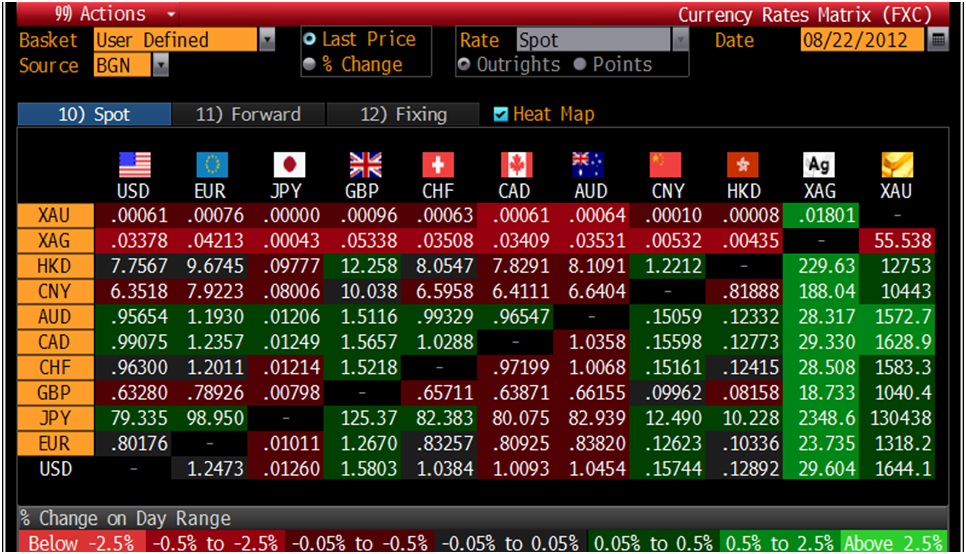
Today's AM fix was USD 1,640.50, EUR 1,315.87, and GBP 1,038.49 per ounce.
Yesterday’s AM fix was USD 1,624.00, EUR 1,308.94and GBP 1,030.26 per ounce.
Silver is trading at $29.44/oz, €23.74/oz and £18.72/oz. Platinum is trading at $1,524.75/oz, palladium at $628.60/oz and rhodium at $1,025/oz.
Gold climbed $16.60 or 1.02% in New York yesterday and closed at $1,637.60. Silver surged to hit a high of $29.501 and finished with a gain of 1.6%.

Gold in USD – 50, 100, 200 Day Moving Average  (Bloomberg)
Gold briefly popped above the 200 day moving average at $1,643/oz this morning and remains near the 3 ½ month high set in the prior session. A break above the 200 day moving average, after similar breaks of the 50 and 100 day moving averages, will be bullish technically (see chart).
Market watchers are still optimistic that the ECB’s Mario Draghi will bring out the bazooka and unleash more euro paper in the form of the SMP program which would be the icing on the cake for what is an already very bullish gold scenario.
Recent news that the ECB has been creating alternatives to limit Spanish and Italian borrowing costs may have sent gold higher yesterday, increasing its inflation hedge appeal.
Later today the FOMC releases the minutes from its latest meeting and investors will search for clues on when QE3 will occur.
Gold’s remonetisation in the international financial and monetary system continues.
LCH.Clearnet, the world's leading independent clearing house, said yesterday that it will accept gold as collateral for margin cover purposes starting in just one week - next Tuesday August 28th.
LCH.Clearnet is a clearing house for major international exchanges and platforms, as well as a range of OTC markets. As recently as 9 months ago, figures showed that they clear approximately 50% of the $348 trillion global interest rate swap market and are the second largest clearer of bonds and repos in the world. In addition, they clear a broad range of asset classes including commodities, securities, exchange traded derivatives, CDS, energy and freight.
The development follows the same significant policy change from CME Clearing Europe, the London-based clearinghouse of CME Group Inc. (CME), announced last Friday that it planned to accept gold bullion as collateral for margin requirements on over-the-counter commodities derivatives.
It is interesting that both CME and now LCH.Clearnet Group have both decided to allow use of gold as collateral next Tuesday - August 28th. It suggests that there were high level discussions between the world’s leading clearing houses and they both decided to enact the measures next Tuesday.
It is likely that they are concerned about ‘event’ risk, systemic and monetary risk and about a Lehman Brothers style crisis enveloping the massive, opaque and unregulated shadow banking system.
Overnight, Citigroup CEO Vikram Pandit warned in Singapore that risks are set to increase as non-bank financial systems expand, adding that it’s impossible for a regulatory body to “see everything.”

Cross Currency Table – (Bloomberg)
LCH.Clearnet Group Ltd.  said it will accept loco London gold as collateral for margin-cover requirements on OTC precious-metals forward contracts and on Hong Kong Mercantile Exchange precious-metals contracts starting Aug. 28. Loco London gold are London Good Delivery Bars (roughly 400-ounce or 12.5 kilograms gold bar) held with LBMA members within the London bullion clearing system.
The clearing house has already been using gold bullion as collateral since 2011 but now will accept loco London gold as collateral.
The push to use gold as collateral follows similar steps from a growing number of exchanges and banks to increase the use of gold as an acceptable deposit and collateral reinforcing gold's renewed status as a safe haven currency.
Intercontinental Exchange Inc. (ICE) also has allowed the use of gold as collateral.
LCH.Clearnet limited the amount of gold that could be used as collateral to no more than 40% of the total margin cover requirement for a member across all products and at a maximum of $200 million, or roughly 130,000 troy ounces, per member group.
The move follows the initiative of the World Gold Council, who last year submitted evidence to the Basel Committee for gold to be included in banks’ ‘Tier 1’ assets by European banking regulators, recognising gold’s growing relevance as a high quality liquid asset.
David Farrar, Director, LCH.Clearnet said at the time that “market participants want greater choice when it comes to assets that can be used as collateral.  Gold is ideal; as an asset it typically performs well in times of financial stress, remains liquid and has a well established pricing mechanism.”

Gold Prices/Fixes/Rates/Vols – (Bloomberg)
We pointed out the importance of this development last year but it was ignored by most of the media and even much of the blogosphere.
The CME and LCH.Clearnet both allowing gold bullion as collateral is extremely bullish for the gold market.
With counterparty and sovereign risk remaining elevated, gold is no longer being seen simply as a commodity. Rather, it is increasingly viewed by market participants as an important asset and a currency with no counterparty risk.
We are gradually seeing the remonetisation and indeed the ’financialisation’ of gold, as gold is gradually being reincorporated into the modern financial and monetary system.
This should result in the coming months and years in markedly higher prices than those of today.
Keynes’s ‘barbaric relic’ is becoming less barbaric by the day. However, the man on the street remains completely unaware of this trend and continues to sell gold (jewellery) rather than buy gold (bullion) as clearly seen in the international phenomenon that is 'cash for gold'.
Huge developments in the gold market such as this continue to be ignored by non specialist financial media and its implications not realized by many so called experts. The "experts" and public consensus is that gold is a risky volatile commodity and may even be a “bubble".”
The truth, which is being seen more clearly by the day, is that gold is actually a finite currency and the safest form of money in the world.
For breaking news and commentary on financial markets and gold, follow us on Twitter.

NEWSWIRE
(Bloomberg) -- CME Clearing Europe to Clear London Silver Forwards from Aug. 28
CME Clearing Europe will start clearing London silver forwards from Aug. 28, it said in an e- mailed statement today.
The product will be physically-settled, it said.
(Bloomberg) -- Lonmin Says Marikana Worker Attendance Falls to 22% From 33%
Lonmin Plc said about 22 percent of the 28,000 workers at its Marikana mine in South Africa reported for duty today compared with 33 percent yesterday.
There probably won’t be any significant production restart this week, Susan Vey, a spokeswoman for the company said by phone from the mine today. The mine will be shut for a memorial service tomorrow, she said. “We’re hoping for a complete change” on Aug. 27, she said.
(Bloomberg) -- Peru’s June Gold Output Fell 5.9% to 13,094 Kg, Ministry Says
Peru’s gold production fell 5.9 percent to 13,094 kilograms in June from a year earlier on declines at Cia. de Minas Buenaventura’s La Zanja mine and Barrick Gold Corp’s Misquichilca mine.
(Bloomberg) – Platinum May Rise With Gold For Six Months
Platinum may rise with gold over the next two quarters, Daniel Brebner, an analyst at Deutsche Bank AG said.
Copper “continues to have problems on the supply side,” Brebner said.  Copper is probably going to a have a shortage this year, not a surplus as expected earlier in the year, he said.
(Bloomberg) -- Pandit Says Shadow Banking Is a Major Concern
Citigroup CEO Vikram Pandit says risks to increase as non-bank financial systems expand, adding that it’s impossible for a regulatory body to “see everything.” He spoke at a speech in Singapore.
? Pandit says investors see opportunity in light regulation in shadow banking
? “Every piece of regulation we are talking about today has but one goal; to enhance the safety and soundness of the financial system. But this goal will not be achieved if all that we accomplish is to impose more requirements on the formal banking sector while leaving the non-bank financial sector relatively untouched.”
(Bloomberg) -- Commodities Enter Bull Market - Gaining 21% 
Commodities entered a bull market, gaining 21 percent from a June low, as grain prices surged after the most severe U.S. drought in half a century and as crude oil rallied amid increased tension in the Middle East.
The Standard & Poor’s GSCI Spot Index of 24 raw materials rose 0.9 percent to end at 675.55 yesterday in New York. The gauge has jumped from this year’s lowest close of 559 on June 21. A gain of more than 20 percent is the common definition of a bull market. Crude accounts for more than 50 percent of index.

NEWS
Gold near 3-1/2 month high on ECB hopes - Reuters

Gold To Rally As Central Banks, Investors Buy, Coutts Says - Bloomberg
Shares slip after Japan exports fall, euro steady - Reuters
Gold Flat in Asia; FOMC Minutes in Focus – Wall Street Journal

COMMENTARY

Why a collapse of the Eurozone must be avoided – Hyperinflation - Vox
What 40 Years Of Gold Confiscation By The US Government Looks Like – Zero Hedge
Is Gold Money? LCH Accepts Shiny Yellow Metal As Collateral – Zero Hedge
Suicidal Skullduggery in the City & Unusually Small Heads on the Street – Max Keiser

Dienstag, 21. August 2012

What 40 Years Of Gold Confiscation By The US Government Looks Like

What 40 Years Of Gold Confiscation By The US Government Looks Like

Tyler Durden's picture


The chart below, which is a time series showing the total "Gold Held by the US Treasury and the Federal Reserve" (which for all intents and purposes are interchangeable), demonstrates vividly the moment when the US government enacted Executive Order 6102, aka the "forbidding the Hoarding of Gold Coin, Gold Bullion, and Gold Certificates within the continental United States" order which criminalized the possession of monetary gold "by any individual, partnership, association or corporation." But not the government of course. Spot the moment after which gold confiscation by the US government (also known as a 40% USD devaluation) from its citizens was legalized.

The actual April 5, 1933 order, which in the coming years will make a repeat appearance with absolute certainty, is below.

What was the point of Executive Order 6102? It was two fold.
  • First, in order to make the confiscation legitimate, the US government required the delivery of all gold coin, bullion, and certificates to be concluded by May 1, 1933 in exchange for $20.67/ounce. Several months later, the new, official gold exchange price (which however was merely the government's bid as nobody could actually buy gold at this price) became $35.00, which remained until 1971 when the last trace of the dollar's pseudo convertibility into gold was wiped out by Nixon. In effect, what FDR did was to devalue the USD by 40% overnight.
  • Second, not only did the government remove the incentive for ordinary citizens to hold gold by establishing price and criminal controls over possession, it also changed the rules in the middle of the game allowing it to build up a massive gold hoard of over 8000 tons today which is maintained at Fort Knox, and is, to the best of our knowledge, unauditable by any mere mortal. Critically, it made the US government the sole source and monopoly agent of gold purchases, using reserve fiat currency it could print with impunity, beginning in 1933 and continuing through 1974 when the limitation on gold ownership was repealed after President Gerald Ford signed a bill legalizing private ownership of gold coins, bars and certificates by an act of Congress codified in Pub.L. 93-373, which went into effect December 31, 1974. In summary, the US government, which is now the largest official holder of physical gold in the world, had 40 years of uncontested zero cost gold accumulation in which it could build a gold inventory that was second to none.
As for the process the government had in place to deal with those who refused to voluntarily hand over their gold quietly, curiously there was only one case of prosecution, which however should make it very clear that holding gold in "authorized" bank safes is about the dumbest thing one can do the next time the US government decides to devalue the dollar, and change the rules.
The circumstances of the case were that a New York attorney, Frederick Barber Campbell, had on deposit at Chase National over 5,000 troy ounces (160 kg) of gold. When Campbell attempted to withdraw the gold Chase refused and Campbell sued Chase. A federal prosecutor then indicted Campbell on the following day (September 27, 1933) for failing to surrender his gold. Ultimately, the prosecution of Campbell failed, but the authority of the federal government to seize gold was upheld, and Campbell's gold was confiscated.
The fact that the custodial bank of the 5000 ounces of gold is the bank that would subsequently become JPMorgan is not lost on us.
Finally, to those who have some gold ETF certificates in a brokerage account, which by law are the possession by DTCC's Cede & Co. - a bank owned institution - we wish the best of luck to anyone hoping to preserve of even recover any of the invested wealth in such instruments.
And remember: when in doubt, recall Bernanke's immortal words: "gold is not money."

Freitag, 13. Juli 2012

Gold und wirtschaftliche Freiheit (Alan Greenspan 1966)

Gold und wirtschaftliche Freiheit (Alan Greenspan 1966)

zitiert nach rsr vom 12.7.2012

Wenn Sie also zu den potenziell

als „reich“ geltenden Bürgern unseres Landes gehören, dann sollten Sie sich noch einmal

mit dem Thema „Gold und wirtschaftliche Freiheit“ beschäftigen. Dankenswerterweise hat
dies bereits ein Mann namens Alan Greenspan im Jahr 1966 getan. Lange bevor dieser einmal

Chef der US-Notenbank FED wurde und dann nicht mehr aus dem Nähkästchen plaudern

konnte und durfte.

Nachfolgend noch mal für alle „Reichen“ und solche die es werden wollen zum Nachlesen

und Nachdenken.

In diesem Sinne alles Gute! Ihre Redaktion von www.rohstoffraketen.de

Gold und wirtschaftliche Freiheit (von Alan Greenspan 1966)

Eine geradezu hysterische Feindschaft gegen den Goldstandard verbindet Staatsinterventionisten

aller Art.
Sie spüren offenbar klarer und sensibler als viele Befürworter der freien

Marktwirtschaft,
dass Gold und wirtschaftliche Freiheit untrennbar sind, dass der Goldstandard

ein Instrument freier Marktwirtschaft ist und sich beide wechselseitig bedingen.

Um den Grund ihrer Feindschaft zu verstehen, muss man zunächst die Rolle des Goldes

in einer freien Gesellschaft verstehen.

Geld ist der gemeinsame Maßstab aller wirtschaftlichen Transaktionen
. Es ist der Rohstoff,

der als Tauschmittel dient, der von allen Teilnehmern einer Tauschgesellschaft als Bezahlung

ihrer Güter und Dienstleistungen akzeptiert wird und der von daher als Bewertungsmaßstab

und zur Wertaufbewahrung für das Sparen dient. Die Existenz eines solchen Rohstoffes ist

Voraussetzung für eine arbeitsteilige Wirtschaft.

Wenn die Menschen keinen objektiv bewertbaren Rohstoff hätten, der allgemein als Geld akzeptiert

werden kann, so wären sie auf primitiven Naturaltausch angewiesen oder gezwungen,

autark auf Bauernhöfen zu leben und auf die unschätzbaren Vorteile der Arbeitsteilung zu verzichten.

Wenn die Menschen kein Mittel zur Wertaufbewahrung, d.h. zum Sparen hätten, wären

weder eine langfristige Planung, noch ein Austausch möglich.

Welches Tauschmittel von allen Wirtschaftsteilnehmern akzeptiert wird, kann nicht willkürlich

bestimmt werden
. Zunächst sollte das Tauschmittel dauerhaft sein. In einer primitiven

Gesellschaft mit geringem Wohlstand könnte Weizen ausreichend „dauerhaft" sein, um als

Tauschmittel zu dienen, da alle Tauschvorgänge nur während der Ernte oder unmittelbar danach

stattfinden würden, ohne das große Werte gelagert werden müssten. Aber sobald Wertaufbewahrung

bedeutsam wird, wie in zivilisierten und reicheren Gesellschaften, muss das

Tauschmittel ein dauerhafter Rohstoff sein, üblicherweise ein Metall.

Ein Metall wird üblicherweise deshalb gewählt, weil es gleichartig und teilbar ist
. Jede

Einheit ist die gleiche wie jede andere und es kann in beliebiger Menge verformt und vermischt

werden. Wertvolle Edelsteine z.B. sind weder gleichartig noch teilbar. Noch wichtiger ist: der

als Tauschmittel gewählte Rohstoff muss ein
Luxusgegenstand sein. Das menschliche Bedürfnis

nach Luxus ist unbegrenzt und deswegen werden Luxusgüter immer nachgefragt und auch

immer akzeptiert.

Weizen ist ein Luxusgut in einer unterernährten Gesellschaft, aber nicht in einer Wohlstandsgesellschaft.

Zigaretten würden normalerweise nicht als Geld dienen, aber nach dem 2. Weltkrieg

wurden sie in Europa als Luxusgut betrachtet.

Der Begriff Luxusgut beinhaltet Knappheit und hohen Wert pro Einheit. Da es einen hohen

Wert pro Einheit besitzt, lässt sich solch ein Gut leicht transportieren. Eine Unze Gold z.B. hat

den Wert von 1/2 Tonne Eisenerz.

Auf den ersten Stufen einer sich entwickelnden Geldgesellschaft mögen mehrere Tauschmittel

benutzt werden, da zahlreiche Rohstoffe die jeweiligen Anforderungen erfüllen können. Mit

der Zeit wird jedoch ein Rohstoff alle anderen verdrängen, weil er größere Akzeptanz findet.

Die Vorliebe für das, was der Wertaufbewahrung dienen soll, wird sich auf den am meisten

verbreiteten Rohstoff konzentrieren, was diesen wiederum noch mehr Akzeptanz finden lässt.

Diese Entwicklung wird sich verstärken, bis dieser Rohstoff zum einzigen Tauschmittel

wird.
Der Gebrauch eines einzigen Tauschmittels hat große Vorteile, und zwar aus den gleichen

Gründen wegen deren eine Geldwirtschaft einer Naturaltauschwirtschaft überlegen ist. Es

ermöglicht einen Austausch in ungleich größerem Umfang. Ob dieses eine Medium nun Gold

ist, Silber, Muscheln, Vieh, oder Tabak, ist beliebig und abhängig von dem Umfeld und der

Entwicklung der jeweiligen Gesellschaft. In der Tat wurde dies alles zu verschiedenen Zeiten

als Tauschmittel verwendet.

Sogar in unserem Jahrhundert wurden zwei bedeutende Rohstoffe, nämlich Gold und Silber, als

internationales Tauschmittel benutzt, wobei Gold das beherrschende wurde. Gold, das sowohl

künstlerischen als auch funktionalen Gebrauch findet und relativ knapp ist, wurde immer als

Luxusgut betrachtet. Es ist dauerhaft, leicht zu transportieren, gleichartig, teilbar und hat deshalb

bedeutende Vorteile gegenüber allen anderen Tauschmittel. Seit Beginn des 1. Weltkrieges

ist es praktisch der einzige internationale Tauschstandard.

Wenn alle Güter und Dienste in Gold bezahlt werden müssten, wären große Zahlungen schwierig

zu bewerkstelligen und dies wiederum würde bis zu einem gewissen Grade den Umfang der

Arbeitsteilung und Spezialisierung einer Gesellschaft begrenzen.

Die logische Fortsetzung der Entwicklung eines Tauschmediums ist es daher, ein Banksystem

und Kreditinstrument (Banknoten und Einlagen) zu entwickeln, die als Stellvertreter funktionieren,

aber in Gold umtauschbar sind.

Ein freies, auf Gold gegründetes Banksystem ist in der Lage, Kredit zu gewähren und so Banknoten

(Währung) und Guthaben zu schöpfen, entsprechend der Produktionserfordernisse der

Wirtschaft. Individuelle Goldbesitzer werden durch Zinszahlungen dazu gebracht, ihr Gold in

einer Bank einzulegen, worauf sie Schecks ziehen können. Und da in den seltensten Fällen alle

Einleger ihr Gold zur gleichen Zeit abziehen wollen, muss der Bankier nur einen Teil der gesamten

Einlage in Gold als Reserve vorhalten. Dies ermöglicht es dem Banker, mehr als seine

Goldanlagen auszuleihen (d.h., er hält Forderungen auf Gold statt wirkliches Gold als Sicherheit

für seine Einlagen).

Aber der Umfang der Ausleihung, die er vornehmen kann, ist nicht willkürlich. Er muss es in

ein Gleichgewicht zu seinen Reserven und dem aktuellen Stand seiner Investitionen bringen.

Wenn Banken Geld ausleihen, um produktive und profitable Unternehmen zu finanzieren, werden

die Ausleihungen rasch zurückgezahlt und Bankkredit ist weiterhin allgemein verfügbar.

Aber, wenn die mit Bankkredit finanzierten Geschäfte weniger profitabel sind und nur langsam

zurückgezahlt werden, spüren die Banker schnell, dass ihre ausstehenden Darlehen zu hoch

sind im Verhältnis zu ihren Goldreserven und sie fangen an, mit neuen Ausleihungen zurückhaltender

zu sein, üblicherweise, indem sie höhere Zinsen berechnen. Dies begrenzt die Finanzierung

neuer Unternehmungen und erfordert von den bestehenden Schuldnern, dass sie ihre

Gewinnsituation verbessern, bevor sie Kredite für weitere Expansionen bekommen können.

Daher wirkt unter dem Goldstandard ein freies Banksystem als Hüter von ökonomischer Stabilität

und ausgeglichenem Wachstum.

Wenn Gold von den meisten oder gar allen Nationen als Tauschmittel akzeptiert wird, so begünstigt

und fördert ein ungehinderter freier Goldstandard weltweit die Arbeitsteilung und einen

umfangreichen internationalen Handel. Obwohl die Tauscheinheiten (Dollar, Pfund, Franc

etc.) von Land zu Land uneinheitlich sind, so funktionieren die Wirtschaften der einzelnen Länder

doch wie eine einheitliche Wirtschaft, wenn die Einheiten alle in Gold definiert sind und

sofern es keine Behinderungen für Handel und freie Kapitalbewegungen gibt. Kredite, Zinsen

und Preise reagieren dann nach gleichartigen Mustern in allen Ländern. Wenn zum Beispiel die

Banken in einem Land zu großzügig Kredit gewähren, gibt es in diesem Land eine Tendenz zu

fallenden Zinsen, was die Goldbesitzer veranlasst, ihr Gold zu Banken in anderen Ländern zu

verlagern, wo es höhere Zinsen bringt. Dies wird unmittelbar zu einer Knappheit an Bankreserven

in dem Land mit den lockeren Kreditbedingungen führen, was wieder zu strengeren Kreditbedingungen

und zu einer Rückkehr zu wettbewerbsgerechten höheren Zinsen führt.

Ein vollkommen freies Banksystem und ein damit übereinstimmender Goldstandard wurde

bisher noch nie verwirklicht
. Aber vor dem 1. Weltkrieg war das Banksystem in den Vereinigen

Staaten (und dem größten Teil der Welt) auf Gold gegründet, und obwohl die Regierungen

zuweilen intervenierten, war das Bankgeschäft doch überwiegend frei und unkontrolliert.

Gelegentlich hatten sich die Banken, aufgrund zu schneller Kreditexpansion, bis an die

Beleihungsgrenzen ihrer Goldreserven exponiert, worauf die Zinssätze scharf anzogen, neue

Kredite nicht gewährt wurden und die Wirtschaft in eine scharfe, aber kurze Rezession fiel (im

Vergleich zu den Depressionen von 1920 und 1932 waren die Konjunkturabschwünge vor dem

1. Weltkrieg in der Tat milde). Es waren die begrenzten Goldreserven, die eine ungleichgewichtige

Expansion der Geschäftstätigkeit stoppten, bevor sie sich zum Desaster entwickeln

konnte, wie es nach dem ersten Weltkrieg geschah. Die Korrekturphasen waren kurz und die

Wirtschaft fand schnell wieder eine gesunde Basis für weitere Expansion.

Aber der Heilungsprozess wurde als Krankheit fehlinterpretiert
. Wenn der Mangel an

Bankreserven einen Konjunkturabschwung bewirkte - so argumentierten die Wirtschaftsinterventionisten

- warum finden wir dann nicht einen Weg, um den Banken zusätzliche Reserven

zur Verfügung zu stellen, so dass sie nie knapp werden müssen.

Wenn die Banken unbegrenzt fortfahren können, Geld zu verleihen - so wurde behauptet

- muss es keine Konjunkturrückschläge mehr geben. Und so wurde 1913 das Federal Reserve

System organisiert
.

Es bestand aus 12 regionalen Federal Reserve Banken, die nominal zwar privaten Bankern ge
hörten, die aber in Wirklichkeit vom Staat gefördert, kontrolliert und unterstützt wurden. Von

diesen Banken geschöpfter Kredit wird praktisch (nicht gesetzlich) von der Steuerkraft der

Bundesregierung unterlegt. Technisch blieben wir beim Goldstandard; Privatpersonen war es

noch erlaubt, Gold zu besitzen und Gold wurde auch noch als Bankreserve benutzt. Aber jetzt

konnte zusätzlich zum Gold auch noch von den Federal Reserve Banken geschöpfter Kredit

(Papiergeldreserven) als legales Zahlungsmittel dienen, um die Einleger zu befriedigen.

Als die Konjunktur in den Vereinigten Staaten 1927 einen leichten Rückschlag erlitt, schöpften

die Federal Reserve Banken zusätzliche Papiergeldreserven in der Hoffnung, damit jeder

Knappheit von Bankreserven zuvorzukommen.

Katastrophaler jedoch war der Versuch der Federal Reserve, Großbritannien zu helfen, welches

Gold an uns verloren hatte, weil die Bank von England sich weigerte, die Zinsen steigen zu lassen,

wie es der Markt erfordert hätte (dies war politisch unerwünscht). Die Argumentationslinie

der beteiligten Instanzen war wie folgt:

Wenn die Federal Reserve massiv Papiergeldreserven in die amerikanischen Banken pumpt,

würden die Zinsen in den Vereinigten Staaten auf ein Niveau fallen, das mit dem in Großbritannien

vergleichbar ist. Dies würde dazu führen, dass die englischen Goldabflüsse gestoppt würden

und politische Unannehmlichkeiten, die mit einer Zinsanhebung verbunden sind, so vermieden

würden.

Die Fed hatte „Erfolg“: Sie stoppte die Goldverluste, aber gleichzeitig zerstörte sie fast die

Weltwirtschaft.
Der übertriebene Kredit, den die Fed in die Wirtschaft pumpte, floss in den

Aktienmarkt - und löste einen fantastischen spekulativen Aktienboom aus. Verspätet versuchten

die Federal Reserve Beamten die Überschussreserven abzusaugen und es gelang ihnen

schließlich, den Boom zu brechen. Aber es war zu spät: 1929 war das spekulative Ungleichgewicht

so überwältigend, dass dieser Versuch einen scharfen Rückgang noch beschleunigte mit

einem daraus folgenden Zusammenbruch des Geschäftsvertrauens. Im Ergebnis brach die amerikanische

Wirtschaft ein.

Großbritannien ging es noch schlechter und statt die vollen Konsequenzen der vorherigen Fehlentscheidungen

zu akzeptieren, verließ es 1931 den Goldstandard komplett und zerriss so völlig

das Netz von Vertrauen, das noch geblieben war, was zu einer weltweiten Serie von Bankzusammenbrüchen

führte. Die Weltwirtschaft verfiel in die große Depression der 30er Jahre.

Mit der gleichen Logik, der sich auch die vorangehende Generation bediente, argumentierten

die Interventionisten, dass in erster Linie der Goldstandard verantwortlich war für das Debakel,

das zur großen Depression führte. Wenn der Goldstandard nicht existiert hätte, so argumentierten

sie, hätte Englands Abgehen von Goldzahlungen in 1931 nicht die Bankzusammenbrüche in

der ganzen Welt verursacht.

Die Ironie dabei war, dass wir seit 1913 keinen Goldstandard mehr hatten, sondern so etwas

wie einen "gemischten Goldstandard", gleichwohl wurde die Schuld aufs Gold geschoben.

Aber die Gegnerschaft gegen den Goldstandard in jeder Form - durch eine wachsende

Zahl von Wohlfahrtsstaat-Befürwortern - wurde von einer viel subtileren Erkenntnis gespeist

- nämlich der Erkenntnis, das der Goldstandard unvereinbar ist mit chronischen

Haushaltsdefiziten (dem Wahrzeichen der Wohlfahrtsstaaten).

Wenn man den akademischen Sprachschleier einmal wegzieht, erkennt man, das der

Wohlfahrtsstaat lediglich ein Mechanismus ist, mit welchem die Regierungen Vermögen

der produktiven Mitglieder einer Gesellschaft konfiszieren, um zahlreiche Wohlfahrtsprojekte

zu finanzieren (unterstützen).

Ein großer Teil der Vermögenskonfiskation erfolgt durch Steuereinziehung. Aber die Wohlfahrtsbürokraten

haben schnell erkannt, dass die Steuerlast begrenzt werden musste, wenn sie

an der Macht bleiben wollten und dass sie auf massives Schuldenmachen ausweichen müssen,

d.h. sie müssen Geld borgen, indem sie Staatsanleihen auflegen, um im großen Stil Wohlfahrtsausgaben

zu finanzieren.

Unter einem Goldstandard wird der Kreditumfang, den eine Wirtschaft verkraften kann, von

den realen Sachwerten der Wirtschaft begrenzt, weil jedes Kreditverhältnis letztlich ein Anspruch

auf einen realen Sachwert ist.

Aber Staatsanleihen sind nicht durch reale Sachwerte unterlegt, sondern nur durch das

Regierungsversprechen, aus künftigen Steuereinnahmen zu bezahlen
. Sie können daher

nicht ohne weiteres von den Finanzmärkten aufgenommen werden. Eine große Menge neuer

Staatsanleihen kann der Öffentlichkeit nur zu ständig steigenden Zinssätzen verkauft werden.

Deshalb ist staatliche Schuldenfinanzierung unter einem Goldstandard eng begrenzt.

Die Abschaffung des Goldstandards ermöglichte es den Verfechtern des Wohlfahrtsstaates,

das Banksystem für eine unbegrenzte Kreditexpansion zu missbrauchen
.

In Form von Staatsanleihen haben sie
Papiervermögen erzeugt, welches die Banken, nach einer

komplexen Folge von Schritten, wie Realvermögen als Sicherheit akzeptieren, gleichsam

als Ersatz für das was früher eine Einlage in Gold war.

Der Inhaber einer Staatsanleihe oder eines auf Papiergeld gegründeten Bankguthabens

glaubt, er hat einen gültigen Anspruch auf Realwerte. In Wirklichkeit sind aber mehr

Ansprüche auf Realwerte im Umlauf, als Realwerte vorhanden sind.

Das Gesetz von Angebot und Nachfrage lässt sich nicht aufheben. Wenn das Angebot an Geld

(Ansprüchen) im Verhältnis zum Angebot von realen Gütern in der Wirtschaft steigt, müssen

die Preise unweigerlich steigen.

Das heißt, Erträge, die von den produktiven Teilen der Gesellschaft erspart wurden, verlieren

in Gütern ausgedrückt an Wert
. Unter dem Strich der Bilanz ergibt sich dann, dass

dieser Verlust genau den Gütern entspricht, die von der Regierung zu Wohlfahrts- und anderen

Zwecken erworben wurden mit dem Geld aus Staatsanleihen, die über Kreditexpansion der

Banken finanziert wurden.

Ohne Goldstandard gibt es keine Möglichkeit, Ersparnisse vor der Enteignung durch Inflation

zu schützen. Es gibt dann kein sicheres Wertaufbewahrungsmittel mehr. Wenn es

das gäbe, müsste die Regierung seinen Besitz für illegal erklären, wie es ja im Falle von

Gold auch gemacht wurde.

Wenn zum Beispiel jedermann sich entscheiden würde, all seine Bankguthaben in Silber, Kupfer

oder ein anderes Gut zu tauschen und sich danach weigern würde, Schecks als Zahlung für

Güter zu akzeptieren, würden Bankguthaben ihre Kaufkraft verlieren und Regierungsschulden

würden kein Anspruch auf Güter mehr darstellen.

Die Finanzpolitik des Wohlfahrtsstaates macht es erforderlich, dass es für Vermögensbesitzer

keine Möglichkeit gibt, sich zu schützen. Dies ist das schäbige Geheimnis, dass hinter

der Verteufelung des Goldes durch die Vertreter des Wohlfahrtsstaates steht.

Staatsverschuldung ist einfach ein Mechanismus für die "versteckte" Enteignung von

Vermögen. Gold verhindert diesen heimtückischen Prozess. Es beschützt Eigentumsrechte.

Wenn man das einmal verstanden hat, ist es nicht mehr schwer zu verstehen, warum

die Befürworter des Wohlfahrtsstaates gegen den Goldstandard sind.

© Alan Greenspan (Originalartikel 1966)

Montag, 9. Juli 2012

South American Silver Plummets As Bolivia Announces It Will Nationalize One Of World's Largest Silver Deposits

CA8363071082

South American Silver Plummets As Bolivia Announces It Will Nationalize One Of World's Largest Silver Deposits


Tyler Durden's picture


Anyone long silver miner South American Silver Corp today is not happy, because while the precious metal responsible for the company top and bottom line has risen significantly, it is our old nationalizing friend, Bolivian President Evo Morales (who last year caused substantial moves higher in silver with threats to nationalize various silver mines in his resource rich if everything else poor country) who has stolen the spotlight, with his latest announcement that he is on his way to nationalize SAC.TO's Malku Khota property, which the company describes as "one of the world's largest undeveloped silver, indium and gallium deposits" and which El Pais adds "is considered one of the largest undeveloped silver deposits, with reserves estimated at 230 million ounces, and at least 2,000 tons of indium, gallium and gold as well." Of course, while this is good news for the actual precious metals as it means much more supply is coming offline, it is very bad for mining and extraction companies such as South American Silver, which stand to lose one after another property to a repeat of last year's wave of nationalization. Indeed, at last check SAC.TO was down 27% today alone and plunging.

This is how Reuters covered the development overnight:
Bolivia will consider nationalizing Canadian miner South American Silver Corp's silver property, President Evo Morales said on Sunday, following violent indigenous protests against the mining project.

Leftist Morales, who last month took control of global commodities giant Glencore's tin and zinc mine in the Andean country, said he hadn't taken a final decision on whether to revoke the Canadian miner's concession.

"Nationalization is our obligation, I already raised the issue of nationalizing (the Malku Khota project) last year, and I told (local residents) to reach an agreement, because when they want we're going to nationalize," Morales told a farmers' gathering.

Exploration work, in which South American Silver plans to invest some $50 million, is expected to end within three years. The company describes it as "one of the world's largest undeveloped silver, indium and gallium deposits."
Then, El Pais provided the following update:
Morales announced that he will nationalize major silver deposits

The Bolivian government withdraw the mining concessions awarded to the South American Silver Canadian company for the exploitation of silver deposits, indium and gallium Mallku Khota the hill, as agreed between government authorities and indigenous communities north of Potosi.

Agreement is reached, local communities agreed to free two engineers of the Canadian mining company and a police officer who had held for several days in order to pressure the government to listen to their demands to break the contract with South American Silver.

The Labor Minister Daniel Santalla, explained that the President Evo Morales is predisposed to reverse the mining concessions but that the decree will take several days due to legal and technical process should be launched for that purpose.

"Nationalize it is our obligation," said Morales in the city itself Colomi in the department of Cochabamba (center), barely a few kilometers from the mine site in question.
Finally, this is what the company itself had to say:
On Sunday the Bolivian Labor Minister, Daniel Santalla, signed an agreement to secure the release of the final three detained individuals with the indigenous opponents to the project. As part of this agreement the opponents were seeking cancellation of the mining concession, however, the government minister acknowledged that this could be difficult due to the original decree giving South American Silver the rights to the project.

Also on Sunday, President Evo Morales and the Government Minister Carlos Romero agreed that a "prior consultation” among all indigenous communities in the project area would be needed to proceed to determine the direction of the project based on the consensus view of all communities.

At this time there has been no change in the status of the project concession. The Company is continuing to work with the government at all levels and with the local communities to agree on an approach to development that is inclusive of all communities in the project area and allows development of the Malku Khota project to its fullest potential.

As noted in earlier updates, Bolivian government authorities have previously stated that there will be a period of constitutionally mandated consultation with local indigenous communities before the project enters the extraction phase.

On May 28 the Mining Minister Mario Virreyra signed an accord with 43 out of 46 indigenous communities in the project area specifying that the state will not reverse the mining concession and stating that the company should continue exploration activities and that Bolivian authorities should provide increased police security in the region.

The vast majority of the indigenous groups in the project area have formally demonstrated their support for the project and understand the social and economic benefits to their communities that the development of a world class, modern mine at Malku Khota will bring and which will create with thousands of well-paying local jobs.

By contrast, the artisanal mining that has been centered near one of three villages in opposition to the project would provide little economic benefit to the 43 other indigenous communities in the project area and has been cited by the Bolivian Mines Minister as causing local environmental damage.

South American Silver has worked closely with the local indigenous communities over the past several years providing significant direct employment on project related jobs, as well as jointly developing programs with the communities to facilitate job training, education, agricultural enhancement and water management for long-term sustainable development.
In conclusion, if before there was any doubt as to why miners trade at such notable discounts to the underlying precious metal, we hope that incidents such as this one give a good glimpse into the real ugly underbelly of what very well may happen to offshore projects if and when destitute countries decide to follow in the path of Argentina and Bolivia.
Finally, for those curious, here is a slideshow of the world's biggest silver mines.
Argentum Emptor.